
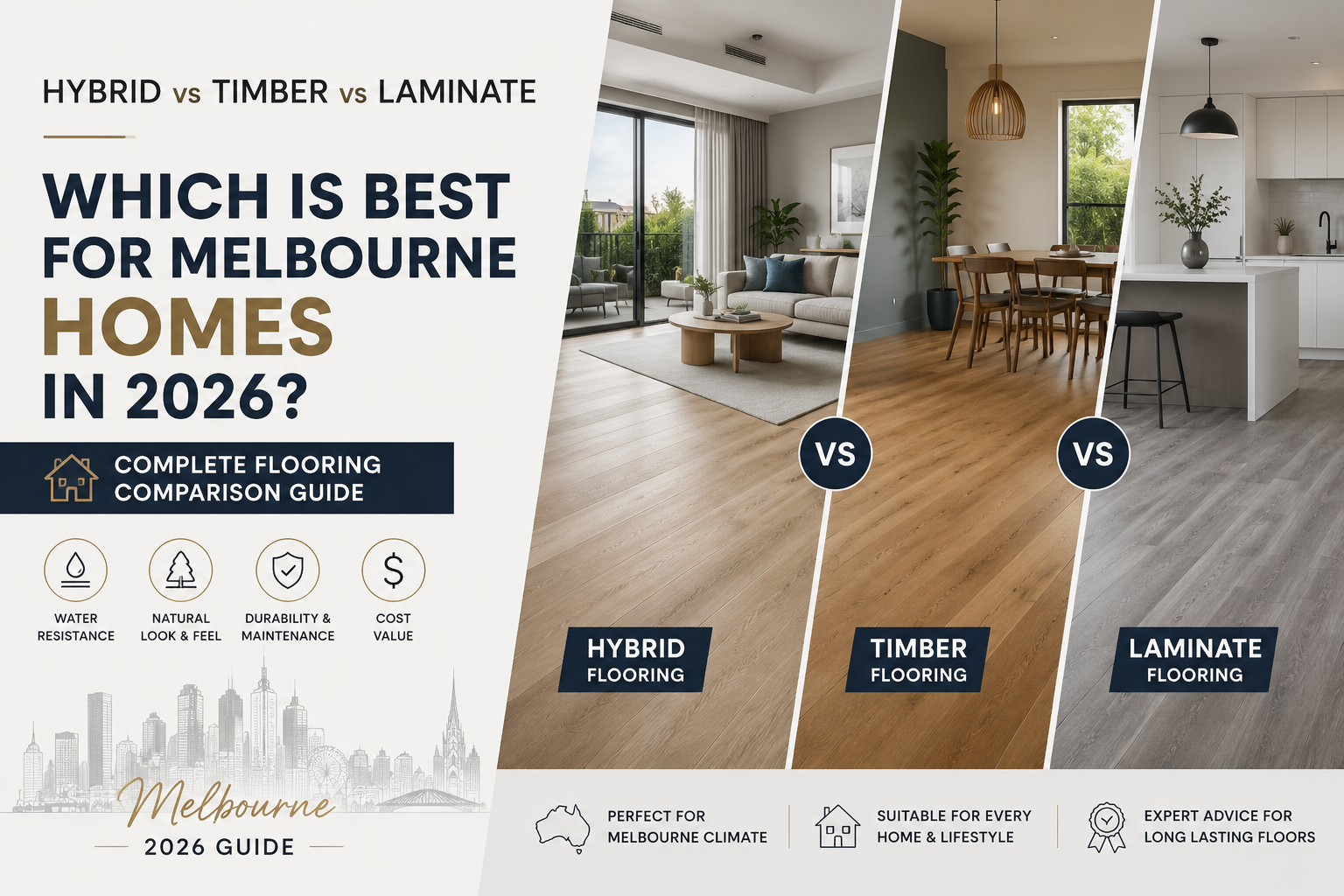
Choosing a new floor can be surprisingly difficult.
Walk into a flooring showroom and you’ll quickly find yourself comparing timber, engineered oak, hybrid SPC, laminate and countless colours, finishes and thicknesses.
Three options are particularly worth comparing for Melbourne homes:
Hybrid flooring vs timber flooring vs laminate flooring.
All three can create a beautiful timber-look interior, but they perform differently when it comes to moisture, durability, maintenance, installation, appearance and cost.
So which one is actually best?
The answer depends on your home and lifestyle.
AP Flooring supplies several flooring categories for Melbourne homeowners, builders, developers and commercial clients, including Engineered Oak Flooring, Australian Timber Flooring, Hybrid SPC Flooring, EVSPC Flooring and Laminate Flooring.
Let’s compare the three most popular options.
Hybrid vs Timber vs Laminate: Quick Comparison
| Feature | Hybrid Flooring | Timber Flooring | Laminate Flooring |
|---|---|---|---|
| Timber appearance | Excellent | Excellent | Very good |
| Water resistance | Excellent* | Lower | Varies |
| Scratch resistance | Very good | Depends on finish | Good |
| Natural feel | Good | Excellent | Moderate |
| Maintenance | Easy | Moderate | Easy |
| Installation | Usually fast | More involved | Usually fast |
| Price | Mid-range | Mid–premium | Budget–mid-range |
| Lifespan | Good–excellent | Excellent with care | Good |
| Refinishing | Usually no | Some timber products can | No |
| Best for | Busy households | Premium interiors | Budget-conscious renovations |
*Always check the specific product’s waterproofing claims and manufacturer’s installation requirements.
1. Hybrid Flooring
Hybrid flooring combines a timber-look surface with a rigid composite core.
SPC hybrid flooring typically uses a rigid Stone Polymer Composite core, giving the product dimensional stability while allowing it to be installed as a floating floor.
Current Melbourne pricing guides commonly put hybrid flooring around $50–$150/m² supplied and installed, depending heavily on product quality and installation conditions.
Why Melbourne Homeowners Choose Hybrid Flooring
Water Resistance
One of hybrid flooring’s biggest attractions is its resistance to moisture.
This makes it attractive for areas where traditional timber or standard laminate may require greater care.
However, don’t assume every hybrid product has identical specifications.
Always check the manufacturer’s installation and waterproofing requirements.
Easy Maintenance
Hybrid floors are generally straightforward to clean.
Regular sweeping or vacuuming followed by appropriate damp cleaning can keep the surface looking good.
Timber-Look Appearance
Modern hybrid flooring can reproduce timber-inspired colours, textures and grain patterns surprisingly well.
This gives homeowners the appearance of timber without necessarily paying timber-flooring prices.
Fast Floating Installation
Many hybrid products use click-lock systems and are installed as floating floors.
That can make installation faster than some glue-down timber applications.
However, the subfloor still matters.
A rigid hybrid floor needs a suitable, sufficiently flat base. Current Melbourne installation guidance highlights subfloor flatness as a major factor in hybrid-floor performance.
Potential Downsides of Hybrid Flooring
Hybrid isn’t perfect.
Depending on the product, disadvantages can include:
- Limited ability to repair deep damage
- Cannot generally be sanded and refinished like solid timber
- Product quality varies significantly
- Poor subfloor preparation can cause installation problems
- Very cheap products may compromise on construction or wear layer
This is why comparing specifications—not just colours—is important.
2. Timber Flooring
If your priority is a natural material and authentic timber appearance, timber flooring remains difficult to beat.
Timber can bring warmth, texture and character to a room that synthetic flooring products can’t completely reproduce.
AP Flooring’s range includes Australian Timber Flooring and Engineered Oak Flooring, giving Melbourne customers options across different timber flooring applications.
Why Choose Timber Flooring?
Natural Appearance
Real timber has natural grain variation.
Every board can have its own character, making the floor feel genuinely individual.
Long-Term Appeal
Timber flooring has remained popular for decades because it can complement both traditional and contemporary interiors.
Potential to Refurbish
Depending on the specific timber product and construction, some timber floors can be sanded, refinished or restored rather than completely replaced.
This can be an important long-term advantage.
Premium Look and Feel
If you’re renovating a high-end home and want the natural appearance of timber, real timber remains one of the strongest choices.
Potential Downsides of Timber
Timber requires more consideration than hybrid flooring.
Potential concerns include:
- Higher upfront cost
- Greater sensitivity to moisture
- More maintenance
- Installation can be more involved
- Natural timber can scratch or dent
- Environmental conditions can affect timber movement
Timber flooring should be selected and installed according to the specific product and site conditions.
3. Laminate Flooring
Laminate is often chosen by homeowners who want the appearance of timber while keeping the project cost under control.
Modern laminate flooring is constructed from multiple layers, including a decorative surface and protective wear layer.
Current Australian pricing guides place laminate material and installation at relatively accessible price points compared with premium timber flooring.
Why Choose Laminate?
Affordable
Laminate is generally one of the more cost-effective ways to achieve a timber-inspired floor.
Huge Range of Designs
There are many colours, plank widths, textures and timber-inspired designs available.
Easy Maintenance
Laminate is generally simple to maintain in normal residential environments.
Good for Renovations
If you’re renovating a property and want to significantly change its appearance without investing in premium timber, laminate can make sense.
Potential Downsides of Laminate
The main issue is moisture.
Traditional laminate should not automatically be treated as waterproof.
There are water-resistant products available, but homeowners should check the exact product specifications before installing it in moisture-prone areas.
Laminate also generally cannot be sanded and refinished like a solid timber floor.
Hybrid vs Timber vs Laminate: Which Is Best for Melbourne?
There isn’t one winner for every home.
Instead, think about what matters most to you.
Choose Hybrid If You Want:
- Easy maintenance
- Strong moisture resistance
- Timber-inspired appearance
- Fast floating installation
- A practical family floor
- A balance between performance and price
Hybrid is particularly attractive for busy households where spills, pets and everyday traffic are concerns.
Choose Timber If You Want:
- Genuine natural timber
- Premium appearance
- Natural texture
- Long-term appeal
- Potential refinishing options
- A high-end renovation finish
Timber is a strong choice when aesthetics and long-term material value matter more than having the lowest upfront price.
Choose Laminate If You Want:
- Lower initial cost
- Timber-inspired appearance
- Easy maintenance
- Lots of design choices
- A practical renovation solution
Laminate can be an excellent option when budget is a major consideration and the installation environment is suitable.
Which Flooring Is Best for Families With Children?
For a family home, practicality often becomes more important than appearance alone.
You may want:
- Easy cleaning
- Good scratch resistance
- Moisture resistance
- Durable surface finishes
- Easy replacement or maintenance
- Comfortable everyday use
Hybrid flooring is often attractive in this situation because of its moisture resistance and easy-care characteristics.
But product quality matters.
A premium hybrid product and a very cheap hybrid product shouldn’t automatically be treated as equivalent.
Which Flooring Is Best for Homes With Pets?
Pets introduce another set of considerations.
Dogs and cats can bring:
- Scratches
- Water spills
- Dirt
- Mud
- Hair
- Claw marks
Hybrid and laminate can both be practical choices, but the specific wear layer and product specifications should be checked.
For timber, the finish and species can influence how the floor handles everyday wear.
The best choice isn’t simply “which floor is strongest?”
It’s which floor gives you the right combination of durability, maintenance and repairability for your lifestyle.
Which Is Cheapest: Hybrid, Timber or Laminate?
Generally:
Laminate → Hybrid → Timber
from lower to higher upfront cost.
However, this isn’t an absolute rule.
Product quality, installation method and project complexity can change the final price significantly.
For example, current Melbourne guides show laminate around $45–$110/m² for many supplied-and-installed projects, hybrid around $60–$150/m², and engineered or solid timber considerably higher depending on the product.
The smartest comparison is therefore total installed cost, not material price alone.
Which Flooring Is Easiest to Maintain?
For everyday cleaning:
Hybrid
Generally very easy to maintain.
Laminate
Also relatively easy to maintain, provided moisture exposure is controlled according to the product requirements.
Timber
Requires more care, particularly around moisture and surface damage.
That doesn’t mean timber is difficult to maintain.
It simply requires a different maintenance approach.
Which Flooring Looks Most Like Real Timber?
If authenticity is the priority:
Real timber wins.
No manufactured flooring can completely replicate the variation and natural character of genuine timber.
However, modern hybrid and laminate products have become significantly better at reproducing timber-inspired textures and colours.
For many homeowners, the difference becomes less about appearance and more about how the floor feels, performs and fits their lifestyle.
Which Flooring Is Best for a Melbourne Renovation?
Melbourne homes vary enormously.
You could be renovating:
- A modern apartment
- A new suburban build
- An older character home
- A family home
- An investment property
- A large open-plan house
The right flooring therefore depends on the property.
Before choosing a product, consider:
Your subfloor
Is it concrete, timber or another substrate?
Moisture
Could the floor be exposed to spills or moisture?
Traffic
How many people use the space every day?
Pets
Do you have dogs or cats?
Budget
Are you looking for budget, mid-range or premium flooring?
Design
Do you want natural timber or a timber-inspired appearance?
Long-term plans
Are you renovating for yourself or preparing the property for sale?
A Simple Decision Guide
If you’re still unsure, start here:
Want the most natural material?
→ Consider timber.
Want a balance between practicality and timber appearance?
→ Consider hybrid.
Want a budget-friendly timber-look renovation?
→ Consider laminate.
Have frequent spills or moisture concerns?
→ Investigate suitable hybrid products.
Want a premium natural interior?
→ Explore engineered or Australian timber flooring.
Want the lowest initial investment?
→ Compare quality laminate options.
Don’t Choose Flooring Based on Price Alone
The cheapest floor isn’t always the cheapest flooring project.
If a product isn’t suitable for your subfloor, lifestyle or environment, problems can appear later.
Likewise, the most expensive floor isn’t automatically the best choice.
A well-selected mid-range product that matches your home’s requirements can be a better investment than paying for features you don’t need.
The key is matching:
Product + installation method + subfloor + lifestyle.
Final Verdict
So, hybrid vs timber vs laminate — which is best?
There is no universal winner.
Hybrid is the practical all-rounder.
It offers a strong combination of moisture resistance, durability, timber-inspired appearance and relatively straightforward installation.
Timber is the premium natural choice.
It provides genuine timber character, a high-end appearance and potential long-term restoration advantages depending on the product.
Laminate is the budget-friendly option.
It can deliver an attractive timber-inspired look without the upfront investment associated with many timber products.
AP Flooring provides Melbourne customers with options including Engineered Oak, Australian Timber, Hybrid SPC, EVSPC and Laminate Flooring, along with professional flooring installation.
The best flooring isn’t necessarily the one with the highest price or the most features.
It’s the one that works best for your home, your lifestyle and your budget.
Frequently Asked Questions
Is hybrid flooring better than timber?
Not necessarily. Hybrid is generally more practical for moisture resistance and easy maintenance, while timber offers a more natural appearance and can provide long-term restoration advantages depending on the product.
Is hybrid flooring better than laminate?
Hybrid is generally more moisture-resistant and dimensionally stable than traditional laminate, but product specifications vary. Budget, room use and installation conditions should all be considered.
Is timber flooring more expensive than hybrid flooring?
Generally, yes. Timber—particularly premium engineered or solid timber—usually costs more than standard hybrid flooring. Current Melbourne pricing guides show substantial variation depending on the product and installation requirements.
What is the best flooring for pets?
Hybrid flooring can be a practical choice for many pet owners because of its easy maintenance and moisture resistance. However, wear-layer specifications and product quality should be considered.
What is the best flooring for a family home?
For many busy households, hybrid flooring offers a useful balance of durability, moisture resistance, maintenance and appearance. Timber and laminate can also be excellent choices depending on the home and budget.
Can laminate flooring get wet?
Traditional laminate should not be assumed to be waterproof. Always check the specific manufacturer’s water-resistance specifications and installation requirements before using it in moisture-prone areas.
How do I choose between hybrid, timber and laminate?
Start with four questions:
What is my budget?
How much moisture will the floor encounter?
How much maintenance am I comfortable with?
Do I want genuine timber or a timber-look product?
Those answers will usually narrow the options considerably.
Looking for flooring in Melbourne, Wallan or Tarneit? Contact AP Flooring Installation to discuss your project and find a flooring solution suited to your property.